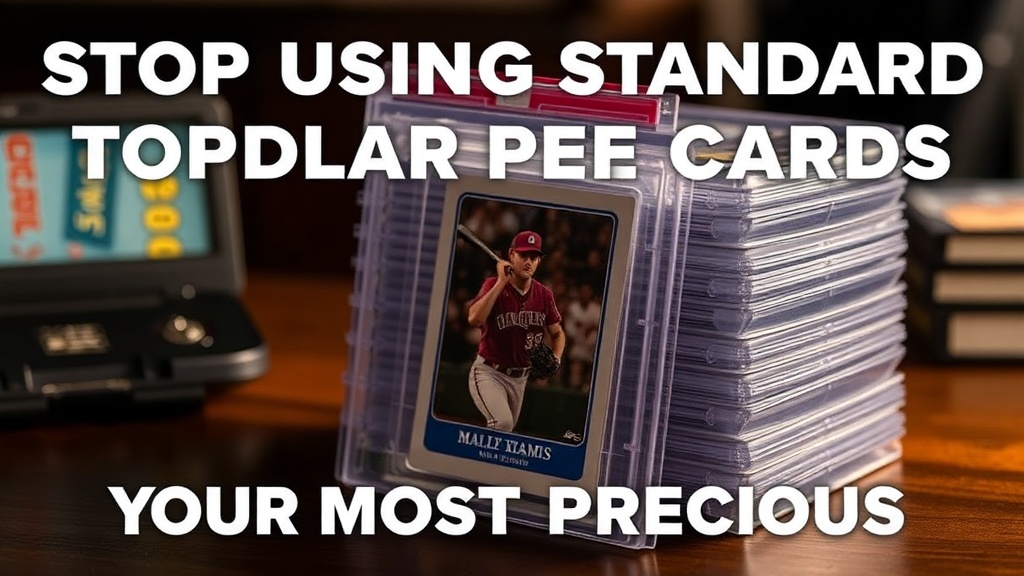
Stop Using Standard Toploaders for Your Most Precious Cards

Quick Tip
Use magnetic one-touch holders for high-value cards to prevent movement and ensure structural integrity.
Most collectors think a standard rigid toploader is the gold standard for protection, but for high-value cards, it's actually a liability. If you're storing a $500 Connor Bedard rookie in a cheap, low-grade plastic sleeve, you're inviting trouble. This post explains why standard toploaders can cause damage and what you should use instead to keep your investment safe.
Why are standard toploaders bad for expensive cards?
Standard toploaders often suffer from "PVC issues" and poor fitment that can lead to surface damage. Many cheap brands use low-grade plastics that contain PVC, which can off-gas over time and leave a greasy residue on your card's surface. Even if they are PVC-free, the rigid nature of a standard toploader doesn't provide the same level of shock absorption as specialized products.
Think about it—if a heavy box drops on your collection, a rigid piece of plastic won't bend, but it also won't absorb the impact. It just transfers that energy directly to the card. (I've seen way too many "gem mint" cards arrive with corner dings because of poor housing.)
Here is a quick breakdown of how different housing options compare:
| Housing Type | Best Use Case | Protection Level |
|---|---|---|
| Standard Toploader | Bulk storage / Low-value cards | Moderate |
| Semi-Rigid Holder | Mid-tier cards | High |
| Graded Slab (PSA/SGC) | High-value investments | Maximum |
What are the best alternatives to toploaders?
The best alternatives depend on whether you want to keep the card "raw" or send it off for grading. For cards you intend to keep in your personal collection, I recommend using high-quality penny sleeves inside a more durable magnetic one-touch holder or a professional-grade semi-rigid holder.
- Magnetic One-Touch Holders: These provide a premium feel and much better structural integrity for high-end cards.
- Graded Slabs: If a card is truly precious, getting it encapsulated by a company like PSA is the only way to ensure long-term stability.
- Semi-Rigid Holders: These offer a middle ground—better than a toploader, but more flexible than a slab.
If you decide to go the grading route, you should also consider choosing the right slab for your high-value hockey cards to ensure the protection matches the card's pedigree.
How do I prevent card damage during shipping?
To prevent damage during shipping, you must use a combination of rigid-to-rigid protection and impact-absorbing materials. Never rely on a single toploader alone for a high-value shipment. You need to sandwich the card between two pieces of heavy cardboard or use a specialized bubble mailer to ensure the card doesn't bend under pressure.
I highly recommend reading my guide on ensuring safe passage when packaging and posting your prized hockey cards before you send out your next big sale. It's a small step that saves a lot of headaches (and money) in the long run.