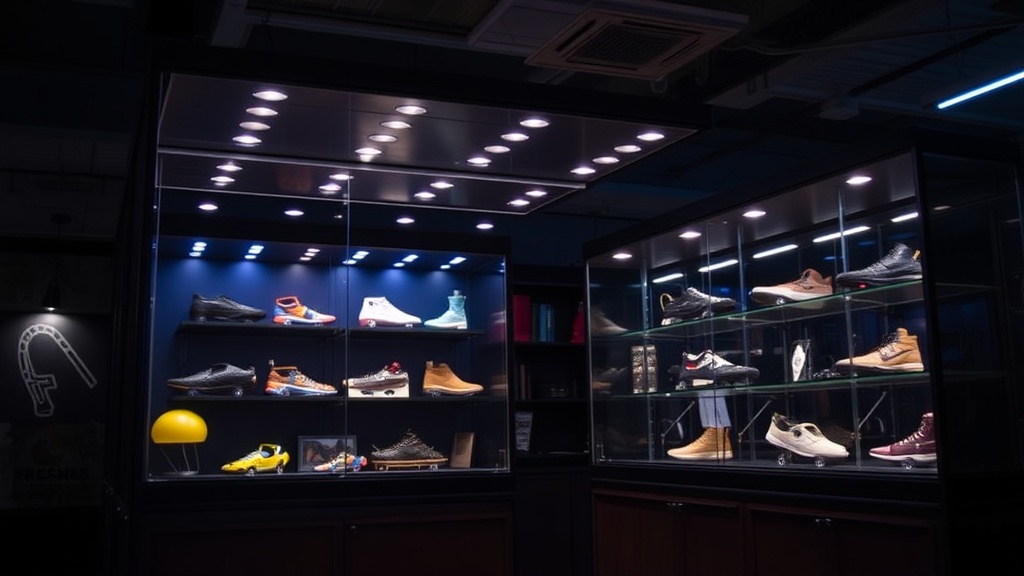
Selecting the Best Lighting for Your Display Case

A collector spends months hunting down a flawless 1979 O-Pee-Chee Wayne Gretzky rookie. He finally gets it into a high-grade slab, places it in a glass display case, and sits back to admire the view. But when he flips the switch, the light is so harsh it creates a blinding glare right over the player's face, or worse—it casts a yellow tint that makes the card look aged and sickly. The card looks dull, and the colors don't pop. This isn't just a visual issue; it's a preservation problem.
Selecting the right lighting for your hockey card display case involves balancing three things: visual clarity, color accuracy, and heat management. If you pick the wrong light, you might actually damage your cards by causing fading or heat-related warping. This guide breaks down how to choose between LED and traditional bulbs, how to manage light temperature, and how to avoid the heat that ruins high-value collections.
How Much Heat Does Lighting Produce Near My Cards?
Most modern LED lights produce very little heat, making them the safest choice for protecting the integrity of your cardboard and plastic holders. Traditional incandescent bulbs or halogen lights generate significant heat, which can cause the air inside a sealed display case to rise in temperature. This heat can lead to "warping" in even the best-protected cards or even cause the glue in certain card stock to degrade over time.
When you're dealing with high-end graded cards, heat is the enemy. If you use a bright halogen bulb to make a collection look "premium," you're actually risking the stability of the environment. You want a light source that stays cool to the touch. If you're unsure about the heat output of a specific bulb, you can check the U.S. Department of Energy resources on lighting efficiency to understand how different types of bulbs convert energy into heat versus light.
I've seen collectors use old-school spotlighting that looks great for a photo, but after two hours, the inside of the case feels warm. That's a bad sign. If your display case feels warm to the touch, your cards are likely experiencing heat stress. Stick to LEDs to keep the temperature stable.
What Is the Best Light Temperature for Trading Cards?
The best light temperature for displaying hockey cards is typically between 4000K and 5000K, as this provides a neutral, daylight-balanced light that shows true colors. If the light is too "warm" (yellowish), your white card borders will look dingy and aged. If it's too "cool" (bluish), the colors of the jersey and the card art might look artificial or washed out.
Think about the specific cards you own. If you have a lot of vintage cards with cream-colored borders, a very bright, white light might make them look "off." On the other hand, modern refractors and holographic cards thrive under a crisp, bright light that highlights the shimmer without making them look washed out.
Here is a quick breakdown of how different Kelvin (K) ratings affect your view:
| Temperature (K) | Light Appearance | Best For... |
|---|---|---|
| 2700K - 3000K | Warm/Yellow | Vintage cards with aged aesthetics. |
| 4000K - 4500K | Neutral White | General collections and most modern cards. |
| 5000K - 6500K | Cool/Daylight | Highlighting holographic and "shiny" textures. |
I always suggest aiming for that middle ground. You want a light that feels natural. It’s a fine line to walk—too much blue and it looks like a hospital; too much yellow and it looks like a dusty basement. You want your collection to look professional, not amateur.
How Do I Prevent Glare on Graded Card Slabs?
To prevent glare, you should use diffused lighting and avoid pointing a direct, single-source light directly at the center of your display case. Most high-value cards are housed in plastic slabs, which act like little mirrors. If you point a bright LED straight at a PSA or BGS slab, the light will bounce right back into your eyes, obscuring the card itself.
There are a few ways to handle this:
- Use Diffused Light: Instead of a single "naked" bulb, use light strips or frosted covers. This spreads the light out.
- Angle the Lights: Instead of pointing the light down at a 90-degree angle, try a 45-degree angle from the sides.
- Layered Lighting: Use multiple low-intensity light sources rather than one high-intensity source.
- Matte Surfaces: Ensure the base of your display case isn't a highly reflective material that bounces light back up at the cards.
If you're currently choosing the right slab for your high-value hockey cards, remember that the plastic is designed to protect, but it also adds a layer of reflectivity. A high-quality LED strip (like those made by Phillips or similar reputable brands) is much easier to control than a single spotlight.
Which Type of LED is Best for a Display Case?
The best LEDs for a display case are high-CRI (Color Rendering Index) strips. A high CRI means the light reveals the true colors of the objects under it. If you use a cheap, low-CRI LED, a bright red jersey on a hockey card might look brownish or dull. You want a CRI of 90 or higher to ensure that the vibrant colors of modern patches and autographs actually look the way they were intended.
When shopping, don't just look at the brightness (lumens). Look at the CRI rating. A light that is very bright but has a low CRI will actually make your collection look worse. It might be "bright," but it won't be "accurate."
Another thing to consider is the physical form factor. You have a few options here:
- LED Strips: These are great for lining the edges of a case. They provide even, indirect light.
- LED Puck Lights: These are better for "spotlighting" a specific card, but you must be careful with the angle to avoid glare.
- LED Bars: These are more substantial and work well if you have a large, deep cabinet.
I personally prefer LED strips. They are thin, easy to hide, and you can run them along the top or bottom edges of the case to create a soft, even glow. It makes the whole collection look like a museum exhibit rather than a cluttered shelf. It also keeps the light source out of your direct line of sight, which helps with the glare issue we discussed earlier.
One thing to watch out for is the "flicker." Some cheap LED drivers have a high-frequency flicker that you might not see with the naked eye, but it can show up in photos or videos. If you plan on filming your collection for social media or YouTube, make sure your lights are high-quality and flicker-free. It's a small detail, but it makes a huge difference in the final look.
It's also worth noting that even with LEDs, you should still avoid placing your display case in direct sunlight. Even "cool" light can cause UV damage over several years. If your display is near a window, the sun will eventually fade those beautiful colors, regardless of what kind of light you've installed inside the case. If you're really worried about UV, you can look into UV-filtering acrylic or glass for your display cases.